I remember the first snow of last year.
I was so sure, unwavering. My path laid before me like rails of a train. Obvious, logical, flawless. Inflexible, fast. Who I was.
And now, first snow has fallen, a year has passed.
Like rails in the summer heat, the air is flickering. They were not my dreams, I do not own them. They were fallacies, assumptions made from an ever-unchanging environment. I have never been more unsure of who I am. Of who I want to be.
The search is slow. Sometimes turbulent, sometimes calm.
If only I knew the direction, I could tell the distance.
I am young, I can't afford this.
I have to.
Friday, November 22, 2013

Tuesday, August 20, 2013
The Success Button
Success sometimes portrays itself as something lucky, far away, as something uncertain. The truth of this portrayal may be debated on, but fact is that this way of thinking only discourages attempts of even attaining success. If no attempts are made, then success is unreachable.
This has been a personal problem of mine some years ago, manifesting itself subconsciously, and resulting often in gaming and procrastination. Games are a promise of success. It is promised, that if you invest time and effort, you will succeed. This is what makes them so appealing to certain groups. Procrastination emerges from the fear of failure. Why invest time in something great, yet uncertain? Why not opt for immediate "happiness"? These questions are what guide the mind, what indirectly nag at motivation. Such reasoning is often hidden away and covered up, difficult to see and understand.
I have found a solution to my problem, and I wish to share it in this text. I hope it helps others with similar mindsets, at least in guidance.
Imagine a big red button. Every-time this button is pressed, there is a small chance of success. It starts out as a minuscule spark. Pressing the button initially, will often result in nothing. This is discouraging, the button after all, is a waste of time. With every push, however, the chance of success rises, with every attempt, something is learned. This is the fundamental truth of success; every attempt increases the chance of attaining it. Every failure is a step towards success. It is evidence that you are human, and of nothing else.
From this perspective, does it not seem ridiculous to avoid pressing this button?
This has been a personal problem of mine some years ago, manifesting itself subconsciously, and resulting often in gaming and procrastination. Games are a promise of success. It is promised, that if you invest time and effort, you will succeed. This is what makes them so appealing to certain groups. Procrastination emerges from the fear of failure. Why invest time in something great, yet uncertain? Why not opt for immediate "happiness"? These questions are what guide the mind, what indirectly nag at motivation. Such reasoning is often hidden away and covered up, difficult to see and understand.
I have found a solution to my problem, and I wish to share it in this text. I hope it helps others with similar mindsets, at least in guidance.
Imagine a big red button. Every-time this button is pressed, there is a small chance of success. It starts out as a minuscule spark. Pressing the button initially, will often result in nothing. This is discouraging, the button after all, is a waste of time. With every push, however, the chance of success rises, with every attempt, something is learned. This is the fundamental truth of success; every attempt increases the chance of attaining it. Every failure is a step towards success. It is evidence that you are human, and of nothing else.
From this perspective, does it not seem ridiculous to avoid pressing this button?
Monday, August 12, 2013
Sole Technical Founder
For the past few weeks I've been working on a SaaS application. For the first time, I'm on my ambitious journey to the sole creator of a product. I wanted to share my experience, as little as it may be, it may yet teach something. I am nowhere near finished, and I expect to learn much more, however I would like to document my feelings during this part of the journey.
I used to look at similar projects of others. In retrospect, I judged them very harshly. If they did not use advanced and top-notch technology, if they did not do something new or mind-blowing, I wouldn't think much of them. It is amazing how my perspective has changed as a result of going through the process myself.
Overwhelming
Being a sole technical founder is an immense and incredibly overwhelming task. The great variety of skills required and things to do make it very difficult to keep track of, and indeed, my largest problem thus far is not getting bogged down by my own thoughts. They are everywhere: marketing, programming, back-end, front-end, shiny new feature, strategy, terms of service, icons, logo, application palette, version control. It is required that I become a jack of all trades, the renaissance man, at least to sufficient extent.
The more I learn, the more it seems, there is to learn. The more I do, the more I see left to do.
Perhaps you do not believe me, like I have never believed. So I will tell you just a little:
On the front-end, there is the simple trio, HTML, CSS, and Javascript. On top of that, there are the abstraction layers, libraries, and frameworks, CoffeScript, Sass, Bootstrap, Skeleton, JQuery, D3.js. I avoided AngularJS/Backbone.js like the plague. I will learn them in my next projects. There is design work to be done, logos to be created, colors to be picked. On the back-end, I've dived into Ruby, Rails, and various gems. Rails alone can take years to master. There should be knowledge of databases, MySql, AJAX, REST/SOAP and MVC architecture, and up to some point, even deeper programming experience such as patterns and anti-patterns. Security, Encryption, Money dealings, Payment Gateways. Not to mention deployment, Stack choice, Scaling, getting things to work together. There is an aspect of law: limits of collecting user data, required logs, fair Terms of Service, and perhaps even patent infringement. There are skills like marketing, managing a business, strategy, product placement, advertisement, pricing, financials, networking, pitching. I cannot even imagine what I've forgotten. These are the things I see from my current point of view, but I know that there will be more to come.
It is impossible to become an expert in all these fields, but I deem it possible to learn enough about them to make informed decisions and to create something of worth. I do not have evidence of this yet. I do however have an immense respect for people who have went through this experience, and I hope to join them at one point in time. All I can do is go step by step. I know once I've learned something, it will go very quickly the next time it comes around. It is a great way to acquire skills; To Do.
Alone
It is lonely work. There is no real-life interaction of similar people for me. I cannot talk about specifics, they are not understood. I try to learn and interact with online communities, it helps, but it does not relieve the need. Sometimes it is beautiful to listen to experts in other fields, and apply it to your own. Sometimes a person inexperienced in this can help, sometimes they discover something "obvious". There is never a real feeling of "sameness" with others in this respect, however.
The worst for me is that I cannot show a large proportion of my work to others. Not because I believe my idea to be so valuable as to be stolen, but because databases don't paint pretty pictures. A successful asynchronous manipulation of a server-side database from within the browser may look like a grey check-box. It is not impressive. There is a long stretch of work which simply cannot be admired. This is common to most programming, however I find that in this, it seems to be more pronounced, and a heavier load. It requires perseverance and belief. There will be no chance of success until you are finished, it is not a steep continuous road to glory, it is a cliff you may jump off after hiking up a forest path, hoping your wings can carry you. You will never find out unless you put in a lot of effort to climb the mountain, and you will climb it alone, in the shadow.
Bottom Line
These are two problems I haven't even considered before. I was not able to notice them until I took some time out to think. They are not glaringly obvious, yet they are very important. As I try dealing with them, I will share whatever proves successful to me.
Please do not misunderstand this post, it was not written to evoke glory or pity. It was written to share.
As for now, I will read 37Signals' book "Rework". It seems to encourage a more simple sight which may help me focus on the important things. Hopefully literature can provide me with a wider perspective and more things to try out once again.
I used to look at similar projects of others. In retrospect, I judged them very harshly. If they did not use advanced and top-notch technology, if they did not do something new or mind-blowing, I wouldn't think much of them. It is amazing how my perspective has changed as a result of going through the process myself.
Overwhelming
Being a sole technical founder is an immense and incredibly overwhelming task. The great variety of skills required and things to do make it very difficult to keep track of, and indeed, my largest problem thus far is not getting bogged down by my own thoughts. They are everywhere: marketing, programming, back-end, front-end, shiny new feature, strategy, terms of service, icons, logo, application palette, version control. It is required that I become a jack of all trades, the renaissance man, at least to sufficient extent.
The more I learn, the more it seems, there is to learn. The more I do, the more I see left to do.
Perhaps you do not believe me, like I have never believed. So I will tell you just a little:
On the front-end, there is the simple trio, HTML, CSS, and Javascript. On top of that, there are the abstraction layers, libraries, and frameworks, CoffeScript, Sass, Bootstrap, Skeleton, JQuery, D3.js. I avoided AngularJS/Backbone.js like the plague. I will learn them in my next projects. There is design work to be done, logos to be created, colors to be picked. On the back-end, I've dived into Ruby, Rails, and various gems. Rails alone can take years to master. There should be knowledge of databases, MySql, AJAX, REST/SOAP and MVC architecture, and up to some point, even deeper programming experience such as patterns and anti-patterns. Security, Encryption, Money dealings, Payment Gateways. Not to mention deployment, Stack choice, Scaling, getting things to work together. There is an aspect of law: limits of collecting user data, required logs, fair Terms of Service, and perhaps even patent infringement. There are skills like marketing, managing a business, strategy, product placement, advertisement, pricing, financials, networking, pitching. I cannot even imagine what I've forgotten. These are the things I see from my current point of view, but I know that there will be more to come.
It is impossible to become an expert in all these fields, but I deem it possible to learn enough about them to make informed decisions and to create something of worth. I do not have evidence of this yet. I do however have an immense respect for people who have went through this experience, and I hope to join them at one point in time. All I can do is go step by step. I know once I've learned something, it will go very quickly the next time it comes around. It is a great way to acquire skills; To Do.
Alone
It is lonely work. There is no real-life interaction of similar people for me. I cannot talk about specifics, they are not understood. I try to learn and interact with online communities, it helps, but it does not relieve the need. Sometimes it is beautiful to listen to experts in other fields, and apply it to your own. Sometimes a person inexperienced in this can help, sometimes they discover something "obvious". There is never a real feeling of "sameness" with others in this respect, however.
The worst for me is that I cannot show a large proportion of my work to others. Not because I believe my idea to be so valuable as to be stolen, but because databases don't paint pretty pictures. A successful asynchronous manipulation of a server-side database from within the browser may look like a grey check-box. It is not impressive. There is a long stretch of work which simply cannot be admired. This is common to most programming, however I find that in this, it seems to be more pronounced, and a heavier load. It requires perseverance and belief. There will be no chance of success until you are finished, it is not a steep continuous road to glory, it is a cliff you may jump off after hiking up a forest path, hoping your wings can carry you. You will never find out unless you put in a lot of effort to climb the mountain, and you will climb it alone, in the shadow.
Bottom Line
These are two problems I haven't even considered before. I was not able to notice them until I took some time out to think. They are not glaringly obvious, yet they are very important. As I try dealing with them, I will share whatever proves successful to me.
Please do not misunderstand this post, it was not written to evoke glory or pity. It was written to share.
As for now, I will read 37Signals' book "Rework". It seems to encourage a more simple sight which may help me focus on the important things. Hopefully literature can provide me with a wider perspective and more things to try out once again.
Friday, July 19, 2013
Reminder of Altruism
Altruism, the act of selflessness. We often see altruism as bringing joy to the "receiver" of the act. This is however, a view from the wrong angle.
At the simplest level, practicing altruism makes you happy. This has been scientifically proven in various studies. Performing an altruistic task brings happiness to oneself. It raises self esteem. It enables positive feelings not only towards a single person, but towards humanity.
Performing an altruistic action will increase your happiness. Will performing this same action do so, however, if this result is your goal? Will the altruistic nature be removed, or is it simply recognized? In my experience, it is the choice which brings happiness, not altruism itself. It is the choice to define yourself as such.
Let us apply this knowledge to improve our happiness. It is very simple.
It should be noted that altruism does not imply sacrifice of the self. It does not imply giving up a part of oneself to the group, or even one person. It can be achieved sometimes by sharing, trusting, and often with little or no real loss. Perhaps it costs one minute of your life to aid an elder person, perhaps it costs ten minutes of your income to raise someone above the poverty level. But what is the purpose of hoarding time if not to be happy? It is an easily overlooked path, yet it pays of immensely.
Imagine a society were altruism is the norm, not selfishness.
Did this fiction make you smile?
At the simplest level, practicing altruism makes you happy. This has been scientifically proven in various studies. Performing an altruistic task brings happiness to oneself. It raises self esteem. It enables positive feelings not only towards a single person, but towards humanity.
Performing an altruistic action will increase your happiness. Will performing this same action do so, however, if this result is your goal? Will the altruistic nature be removed, or is it simply recognized? In my experience, it is the choice which brings happiness, not altruism itself. It is the choice to define yourself as such.
Let us apply this knowledge to improve our happiness. It is very simple.
It should be noted that altruism does not imply sacrifice of the self. It does not imply giving up a part of oneself to the group, or even one person. It can be achieved sometimes by sharing, trusting, and often with little or no real loss. Perhaps it costs one minute of your life to aid an elder person, perhaps it costs ten minutes of your income to raise someone above the poverty level. But what is the purpose of hoarding time if not to be happy? It is an easily overlooked path, yet it pays of immensely.
Imagine a society were altruism is the norm, not selfishness.
Did this fiction make you smile?
Sunday, May 19, 2013
Journey
This piece is about my departure from Switzerland in sight of Japan.
There is no information contained within, simply emotion.
I realize there is not much to pack. A suitcase, a backpack.
My life resides in people, in technology.
There are things strewn around my room, yet most will not travel with me on my journey. There are books. So many books. I decide to take with me two of my favorite narratives. The others reside in my thoughts, my behavior. Most informational books have taught me what they know, have expired their purpose for me. They will help another individual achieve. Notebooks, papers, full of arrangements and ideas. I pick a pocket sized one containing the summaries of my plans. There is a stack of legal papers I am required by society to assign value to. A photo. A pen. Memories.
My computer. I remember having put the pieces together three years ago. Each one had been picked to balance cost and performance. I was overjoyed when it turned on. I now take it a part, for the second time, it must come with me. We will return to our shared home. It has served me well. It is my tool of choice, my capability. I dust off each piece. I leave the case and the monitor, the dvd-drive, and the floppy drive I had jokingly built in. Unnecessary weight. A cable, some screws, my keyboard. I need my keyboard.
I pack my clothes.
I wrap the fragile pieces.
They belong in boxes.
I stare at my suitcase, at my backpack, at the clothes I will wear tomorrow.
I feel humbled. Is this my life?
I will go home.
I will find rest.
There is no information contained within, simply emotion.
I realize there is not much to pack. A suitcase, a backpack.
My life resides in people, in technology.
There are things strewn around my room, yet most will not travel with me on my journey. There are books. So many books. I decide to take with me two of my favorite narratives. The others reside in my thoughts, my behavior. Most informational books have taught me what they know, have expired their purpose for me. They will help another individual achieve. Notebooks, papers, full of arrangements and ideas. I pick a pocket sized one containing the summaries of my plans. There is a stack of legal papers I am required by society to assign value to. A photo. A pen. Memories.
My computer. I remember having put the pieces together three years ago. Each one had been picked to balance cost and performance. I was overjoyed when it turned on. I now take it a part, for the second time, it must come with me. We will return to our shared home. It has served me well. It is my tool of choice, my capability. I dust off each piece. I leave the case and the monitor, the dvd-drive, and the floppy drive I had jokingly built in. Unnecessary weight. A cable, some screws, my keyboard. I need my keyboard.
I pack my clothes.
I wrap the fragile pieces.
They belong in boxes.
I stare at my suitcase, at my backpack, at the clothes I will wear tomorrow.
I feel humbled. Is this my life?
I will go home.
I will find rest.
Friday, May 3, 2013
Quitting University
I have decided to Quit University. I have made this decision four weeks ago, and I've stuck with it until now, and thus, I will now go through with it. Here I will elaborate on some of my thoughts and problems. Perhaps this will help somebody.
A Dream
During my years in high-school, it was my dream to go to a good University. I wished to learn freely, to learn what interested me, to meet like-minded people. I imagined myself free of the things I considered a burden in high-school. Boring homework, boring people, annoying restrictions, incredibly wasteful time-sinks, and most importantly, the freedom to learn how and what I wanted to learn at my own pace. Perhaps I would attain a Masters after my Bachelors, perhaps I would become somebody. I worked hard during my last school year to realize this dream. I passed all the necessary AP's and attained high enough grades. It payed off, and I do not regret a single ounce of this effort. I was overjoyed to be accepted into one of the top 100 universities in the world, located in Switzerland, my home country. My future was guaranteed, I would be someone important, I would be happy.
A Disappointment
It has been a year now since I've begun. I changed a lot, I learned a lot about myself. I am not happy living my dream. I lost my dream.
It was a completely new world for me. I was allowed to study at my own pace and I did not even have to attend most classes. I rarely met a person I admired, however. An inspirational person, somebody I would strive to become. All the computer science classes during my first year would be a repeat of what I already knew. Nevertheless, rarely, a new concept would pop up and surprise me. I was only restricted to passing the tests at the end of the semester. I thought it was great.
As the year progressed, however, I grew to dislike it more and more. I did not want to implement heaps and sorting algorithms in C, I wanted to learn Rails and the negatives of Iterative MVP's. I did not care for obscure formats and protocol, I wanted to create. I wanted to learn as a part of the creation process. I wanted to do, I wanted to make, I wanted to construct my fantasies as I had been doing before. The end tests started hanging over me like a dark cloud, a stressor directing me to study. The only reason I continued to go was job security. A piece of paper. I lost who I wanted to be by being someone else.
Social Stigma
It is really hard to make a decision on this matter without taking into consideration the social stigma associated with it. One is easily labeled as a drop-out, as stupid and of little or no importance.
Many associate dropping out of university with being impulsive and rash. It is often perceived that long-term thinking plays no part in it, that it is a decision made in the absence of thought. Often, this also comes with the belief that one will stop learning. That as soon as the "dropping out" has commenced, laziness and partying will follow. It is a widely held belief that University is the only opportunity to advance a career, that the person in question will work a menial job for the rest of his life.
Many beliefs on this matter are outdated, and some only apply to specific regions of the job market. Most are blatantly wrong, however. It is difficult to overcome such thinking, to see through what one has been taught an entire life. It is difficult to remove this pressure to follow a path many wish to follow, a path which for many may be correct.
The Road Ahead
I believe studying computer science is a mistake for me, however. A certificate can be replaced by experience and evidence of such. In the world of technology, you are free to create masterful pieces, show them to the world, prove your expertise. You are free to learn the technologies you require, free to join societies you benefit from. This road is more difficult without doubt, yet I believe it will be the one leading me to happiness.
I trust that I can succeed. As of now, I do not have much evidence of this. The next two years will be spent expanding my skills and acquiring this evidence. I believe I will be further in two years, than I would be if I, alternatively, get my degree.
I am planning to learn a new language and publish a book. More importantly, however, I am planning to finish a programming project every month. I want to be ambitious, I want to push my wall further than I can even now imagine.
I will be documenting my Journey on this Blog.
Join Me,
Simon
A Dream
During my years in high-school, it was my dream to go to a good University. I wished to learn freely, to learn what interested me, to meet like-minded people. I imagined myself free of the things I considered a burden in high-school. Boring homework, boring people, annoying restrictions, incredibly wasteful time-sinks, and most importantly, the freedom to learn how and what I wanted to learn at my own pace. Perhaps I would attain a Masters after my Bachelors, perhaps I would become somebody. I worked hard during my last school year to realize this dream. I passed all the necessary AP's and attained high enough grades. It payed off, and I do not regret a single ounce of this effort. I was overjoyed to be accepted into one of the top 100 universities in the world, located in Switzerland, my home country. My future was guaranteed, I would be someone important, I would be happy.
A Disappointment
It has been a year now since I've begun. I changed a lot, I learned a lot about myself. I am not happy living my dream. I lost my dream.
It was a completely new world for me. I was allowed to study at my own pace and I did not even have to attend most classes. I rarely met a person I admired, however. An inspirational person, somebody I would strive to become. All the computer science classes during my first year would be a repeat of what I already knew. Nevertheless, rarely, a new concept would pop up and surprise me. I was only restricted to passing the tests at the end of the semester. I thought it was great.
As the year progressed, however, I grew to dislike it more and more. I did not want to implement heaps and sorting algorithms in C, I wanted to learn Rails and the negatives of Iterative MVP's. I did not care for obscure formats and protocol, I wanted to create. I wanted to learn as a part of the creation process. I wanted to do, I wanted to make, I wanted to construct my fantasies as I had been doing before. The end tests started hanging over me like a dark cloud, a stressor directing me to study. The only reason I continued to go was job security. A piece of paper. I lost who I wanted to be by being someone else.
Social Stigma
It is really hard to make a decision on this matter without taking into consideration the social stigma associated with it. One is easily labeled as a drop-out, as stupid and of little or no importance.
Many associate dropping out of university with being impulsive and rash. It is often perceived that long-term thinking plays no part in it, that it is a decision made in the absence of thought. Often, this also comes with the belief that one will stop learning. That as soon as the "dropping out" has commenced, laziness and partying will follow. It is a widely held belief that University is the only opportunity to advance a career, that the person in question will work a menial job for the rest of his life.
Many beliefs on this matter are outdated, and some only apply to specific regions of the job market. Most are blatantly wrong, however. It is difficult to overcome such thinking, to see through what one has been taught an entire life. It is difficult to remove this pressure to follow a path many wish to follow, a path which for many may be correct.
The Road Ahead
I believe studying computer science is a mistake for me, however. A certificate can be replaced by experience and evidence of such. In the world of technology, you are free to create masterful pieces, show them to the world, prove your expertise. You are free to learn the technologies you require, free to join societies you benefit from. This road is more difficult without doubt, yet I believe it will be the one leading me to happiness.
I trust that I can succeed. As of now, I do not have much evidence of this. The next two years will be spent expanding my skills and acquiring this evidence. I believe I will be further in two years, than I would be if I, alternatively, get my degree.
I am planning to learn a new language and publish a book. More importantly, however, I am planning to finish a programming project every month. I want to be ambitious, I want to push my wall further than I can even now imagine.
I will be documenting my Journey on this Blog.
Join Me,
Simon
Tuesday, April 30, 2013
Productivity
Productivity is a precarious game of balance. I've only recently started to focus on maximizing this enigmatic variable. Here I will share my efforts with the most success. For productivity, I believe, it is necessary to be of good mental and physical health. Additionally, good time management is required. These things are easier to quantify than productivity itself, lending themselves well to visible change.
Mental Health
Meditation is the single biggest improvement I have been able to work in this area. It has given me the ability to see clearly, to understand and remove unnecessary feelings, and to magnify the person I wish to be. It has allowed me to define clear goals, to analyze my habits daily, introduce new ones, and remove old ones. It is a time specifically allotted in my day to think, to understand myself. The payoff has been beyond my wildest skepticism's.
There are countless schools of meditation and it has taken me some persistence to find the correct one. I began with a school which teaches to empty the mind and remove all thought. This type of meditation was not for me. Due to fortunate circumstances, I stumbled over a book: "Mindfulness in Plain English". The free pdf is available here. It is a short book, I highly recommend reading it. It is the introduction to meditation I wish I had.
The goal of these teachings is to be aware of ones own mind. Rather than shutting off all thought, one removes the self from the thinking process and watches from a distance. It is incredibly what I have discovered about myself during the first ten minutes of attempting this. It convinced me beyond doubt to keep going.
It may be hard to begin the habit of meditation. The book also offers an amazing insight to the solution of this problem. The author urges to force meditation daily, however only for a few seconds to begin. As with all habits, he argues, once the seed is planted, it is easier to expand upon the pattern of thought.
Physical Health
Physical health is also largely defined by habit. Daily decisions cause long-term consequences. Changes in habit take some time to display, and thus it is difficult to stick with something long enough to see the advantages. I can only tell you that improvements will have a significant impact on your life.
I have found that exercising twice a week bears many advantages. Most are hard to see however. They include improvements in posture, and strikingly, mood. Often the mind makes many excuses against exercising. I have found all of mine to be null and void through meditation. I have found that a healthy mind can thus lead to a healthy body, the inverse being valid likewise.
The largest improvement I have observed however, comes from a steady sleep schedule. It is impossible to expect to wake up refreshed after a long nights sleep if you suffer from chronic sleep deprivation. Why people do it, is beyond me. I have found that a steady pattern of sleeping takes at least half a month to take effect, however the consequences of sleeping at the same time, 8 hours a night, are incredible.
As with meditation, these habits are perhaps best introduced by gradual change. Do one minute of pure exercise bi-weekly. Most likely, your body will even ask for you to keep going. If not, you still have planted the seed. Sleep half an hour early, wake half an hour early. Iterate weekly until you are convinced of positive or negative change.
Time Management
It has taken me long to find a good time management technique. I am currently convinced however, that at least I have found a good one to begin with.
The pomodoro technique (site) is humorously named after the tomato timer. This technique encourages setting aside 25 minute blocks of time. During these "pomodoros", interruptions are not allowed, and are actively removed. The goal is to work non-stop, highly concentrated, on a single task. A five minute rest is then granted. During this time you may not think about what you are planning to work on, or what you worked on. You should let your mind wander towards unrelated things, make a tea, or chat with a friend. Repeat the process.
I have found the five minute breaks to be crucial. It is easy to get carried away by a fun project, only to discover after an hour of non-stop thinking, that your mind has grown wary and your mood has grown stressed. These forced five-minute breaks allow for recuperation and in the end, a longer time of productivity.
There is much more to this technique than I have covered, however it is enough to try it out. Set aside 25 minutes, work uninterruptedly, and be amazed at the results. It is only half an hour, yet it could change the way you live a large part of your life. In this category, at least, it is possible to see fast results.
I am aware that techniques vary from person to person, however I strongly encourage attempting to improve yours. Discover and try new things. There is so much to gain.
I am interested in your discoveries,
Simon
Mental Health
Meditation is the single biggest improvement I have been able to work in this area. It has given me the ability to see clearly, to understand and remove unnecessary feelings, and to magnify the person I wish to be. It has allowed me to define clear goals, to analyze my habits daily, introduce new ones, and remove old ones. It is a time specifically allotted in my day to think, to understand myself. The payoff has been beyond my wildest skepticism's.
There are countless schools of meditation and it has taken me some persistence to find the correct one. I began with a school which teaches to empty the mind and remove all thought. This type of meditation was not for me. Due to fortunate circumstances, I stumbled over a book: "Mindfulness in Plain English". The free pdf is available here. It is a short book, I highly recommend reading it. It is the introduction to meditation I wish I had.
The goal of these teachings is to be aware of ones own mind. Rather than shutting off all thought, one removes the self from the thinking process and watches from a distance. It is incredibly what I have discovered about myself during the first ten minutes of attempting this. It convinced me beyond doubt to keep going.
It may be hard to begin the habit of meditation. The book also offers an amazing insight to the solution of this problem. The author urges to force meditation daily, however only for a few seconds to begin. As with all habits, he argues, once the seed is planted, it is easier to expand upon the pattern of thought.
Physical Health
Physical health is also largely defined by habit. Daily decisions cause long-term consequences. Changes in habit take some time to display, and thus it is difficult to stick with something long enough to see the advantages. I can only tell you that improvements will have a significant impact on your life.
I have found that exercising twice a week bears many advantages. Most are hard to see however. They include improvements in posture, and strikingly, mood. Often the mind makes many excuses against exercising. I have found all of mine to be null and void through meditation. I have found that a healthy mind can thus lead to a healthy body, the inverse being valid likewise.
The largest improvement I have observed however, comes from a steady sleep schedule. It is impossible to expect to wake up refreshed after a long nights sleep if you suffer from chronic sleep deprivation. Why people do it, is beyond me. I have found that a steady pattern of sleeping takes at least half a month to take effect, however the consequences of sleeping at the same time, 8 hours a night, are incredible.
As with meditation, these habits are perhaps best introduced by gradual change. Do one minute of pure exercise bi-weekly. Most likely, your body will even ask for you to keep going. If not, you still have planted the seed. Sleep half an hour early, wake half an hour early. Iterate weekly until you are convinced of positive or negative change.
Time Management
It has taken me long to find a good time management technique. I am currently convinced however, that at least I have found a good one to begin with.
The pomodoro technique (site) is humorously named after the tomato timer. This technique encourages setting aside 25 minute blocks of time. During these "pomodoros", interruptions are not allowed, and are actively removed. The goal is to work non-stop, highly concentrated, on a single task. A five minute rest is then granted. During this time you may not think about what you are planning to work on, or what you worked on. You should let your mind wander towards unrelated things, make a tea, or chat with a friend. Repeat the process.
I have found the five minute breaks to be crucial. It is easy to get carried away by a fun project, only to discover after an hour of non-stop thinking, that your mind has grown wary and your mood has grown stressed. These forced five-minute breaks allow for recuperation and in the end, a longer time of productivity.
There is much more to this technique than I have covered, however it is enough to try it out. Set aside 25 minutes, work uninterruptedly, and be amazed at the results. It is only half an hour, yet it could change the way you live a large part of your life. In this category, at least, it is possible to see fast results.
I am aware that techniques vary from person to person, however I strongly encourage attempting to improve yours. Discover and try new things. There is so much to gain.
I am interested in your discoveries,
Simon
Monday, April 22, 2013
Deciding to Lose Freedom
Freedom is widely perceived as a purely good thing. It is most often defined as the ability to act as one wants, lacking external restraints and regulations.
A small thought experiment will introduce my premise. You are fully free, and you are facing a decision between freedom and imposing restraints on your future self. Would you not instantly decide for freedom?
Yet, we often are happiest when we have placed restraints on ourselves. When we have decided to do so, when we have decided to allow external control over part of our lives. Marriage, for example, can be seen as a decision to restrict your future actions. Ignoring legal and financial advantages, many would nevertheless, happily decide to bind themselves to one person for the rest of their lives. The breaking of such a restriction would result in negative consequences, perhaps social, perhaps legal, perhaps otherwise. Another example could be the restriction of alcohol consumption on the self. Simply an imposed diet, an exercise routine, or a sleeping schedule, also match the criteria. Perhaps a dream of talent is supported by forcing bi-daily practice. Perhaps actions are taken to introduce negative consequences if these things do not happen.
Freedom of people are lost through such decisions, however, it has not stopped them from achieving their dreams. It has guided them, it has provided consistency and removed impulsiveness. It has set a framework for the future self.
We are often so quick to judge those which give up their freedom, yet exactly such myopic vision prevents us from seeing advantages in restriction. We are scared of truly deciding, of truly living.
It is like the horse (桂馬) in Shogi. Every turn, the horse has the decision of two open moves. Taking one removes the possibility of ever taking the other. Yet, the horse steadily moves forward after every decision, and upon reaching the other side, is granted a more flexible set of motions.
A small thought experiment will introduce my premise. You are fully free, and you are facing a decision between freedom and imposing restraints on your future self. Would you not instantly decide for freedom?
Yet, we often are happiest when we have placed restraints on ourselves. When we have decided to do so, when we have decided to allow external control over part of our lives. Marriage, for example, can be seen as a decision to restrict your future actions. Ignoring legal and financial advantages, many would nevertheless, happily decide to bind themselves to one person for the rest of their lives. The breaking of such a restriction would result in negative consequences, perhaps social, perhaps legal, perhaps otherwise. Another example could be the restriction of alcohol consumption on the self. Simply an imposed diet, an exercise routine, or a sleeping schedule, also match the criteria. Perhaps a dream of talent is supported by forcing bi-daily practice. Perhaps actions are taken to introduce negative consequences if these things do not happen.
Freedom of people are lost through such decisions, however, it has not stopped them from achieving their dreams. It has guided them, it has provided consistency and removed impulsiveness. It has set a framework for the future self.
We are often so quick to judge those which give up their freedom, yet exactly such myopic vision prevents us from seeing advantages in restriction. We are scared of truly deciding, of truly living.
It is like the horse (桂馬) in Shogi. Every turn, the horse has the decision of two open moves. Taking one removes the possibility of ever taking the other. Yet, the horse steadily moves forward after every decision, and upon reaching the other side, is granted a more flexible set of motions.
Sunday, April 14, 2013
Love and Distance
Note: Read this blog selectively. This post is about love and distance. It's a post with the purpose of expressing my emotions and feelings. If that's not your cup of tea, don't drink it. Don't waste tea. Seriously. =)
9814 kilometers, the blink of an eye, enough to bind the heart for a lifetime. As the snow melts, and flowers break their spell, I breathe in. I remember this smell, the smell of freedom and energy, a combination of rain and sun. A lonely snowflake kisses my nose, only to loose its form, but never it's nature. Leaves whisper, as the wind relays their message. The sun shines through the trees, and I remember.
Sitting under a tree, careless. I felt the warmth of a breath, and the rhythm of a heart. We shared a universe, and it was ours. I remember, simply walking, with a familiar hand to hold. I remember watching as the birds flew by above, my mind joined them, and reached for the sun. I remember kissing in heavy rain, perfectly content, knowing that a dry place would take five steps to reach. I remember holding each other, listening to the ocean with closed eyes, being one with nature, feeling calm, as if time stood still. I remember going out in the middle of the night to buy ice cream, her head in my lap, and reaching for the stars, on a lonely wooden bench by the river. I remember her shock when the koi threatened to eat her, hearing sparrows chirp as a gong rings in the distance, her face.
I imagine her face, completing mine. I imagine the smell of her hair, the look in her eyes, the taste of her lips, the feeling of her soft, small hands. I yearn to see her paint with concentration in her eyes, to see her read with wonder, to see her cook with her weight on one leg, to see her be. I yearn to share my experiences with her; days of snow, days of rain, days of wind, days of sun. Hiking, cycling, swimming, walking, discovering, breathing, being.
Together.
I breathe out. I let go. An infinity of sensations leaves me.
They return in my next breath.
I don't ask for much, yet I ask for everything.
9814 kilometers, the blink of an eye, enough to bind the heart for a lifetime. As the snow melts, and flowers break their spell, I breathe in. I remember this smell, the smell of freedom and energy, a combination of rain and sun. A lonely snowflake kisses my nose, only to loose its form, but never it's nature. Leaves whisper, as the wind relays their message. The sun shines through the trees, and I remember.
Sitting under a tree, careless. I felt the warmth of a breath, and the rhythm of a heart. We shared a universe, and it was ours. I remember, simply walking, with a familiar hand to hold. I remember watching as the birds flew by above, my mind joined them, and reached for the sun. I remember kissing in heavy rain, perfectly content, knowing that a dry place would take five steps to reach. I remember holding each other, listening to the ocean with closed eyes, being one with nature, feeling calm, as if time stood still. I remember going out in the middle of the night to buy ice cream, her head in my lap, and reaching for the stars, on a lonely wooden bench by the river. I remember her shock when the koi threatened to eat her, hearing sparrows chirp as a gong rings in the distance, her face.
I imagine her face, completing mine. I imagine the smell of her hair, the look in her eyes, the taste of her lips, the feeling of her soft, small hands. I yearn to see her paint with concentration in her eyes, to see her read with wonder, to see her cook with her weight on one leg, to see her be. I yearn to share my experiences with her; days of snow, days of rain, days of wind, days of sun. Hiking, cycling, swimming, walking, discovering, breathing, being.
Together.
I breathe out. I let go. An infinity of sensations leaves me.
They return in my next breath.
I don't ask for much, yet I ask for everything.
Thursday, April 4, 2013
Persistence
It's been three years since I've posted anything, and a lot has changed.
Why did I start blogging again?
The aim of this blog is to provide me with an outlet for my ideas and thoughts. Perhaps I get to enjoy the company of people like you, reading my blog, and perhaps you decide to contribute, or perhaps you learn something, or perhaps, you enjoy run-on sentences as much as I do. Whatever the case, I believe more good will come out of publicizing my posts, than bad.
I decided to continue my old blog, rather than start a new one. While some of my old posts may not reflect who I am at the moment, I believe it is healthy to accept who you once were. If I separated the new me from the old me, I believe I would not be doing that.
My Current Situation
I finished high school, quite well, I might add, and entered a university. I just started my second semester, after having an admittedly disastrous first one. While I'm trying to get as much out of university as possible, I'm mainly going through it for future security.
For the past 9 years, half of my life, in fact, I've lived in Japan. After graduating from an international school there, I moved to Switzerland (my home country) for my Bachelors. Currently it is in Software Systems, however it could change into one of Business Informatics with a strong focus on Economics. Frankly, I will, as I did with my choice of university, pick the one allowing me for more freedom of my studies. This includes free time, and course choice.
I've found that I learn a lot faster by myself, at least at this stage. I wouldn't be surprised that this will stop being the case at some point. I just began learning Ruby and Rails simultaneously, and I'm amazed at the power and speed at which one individual can accomplish things. I'm aiming to acquire these skills as quickly as possible, while not sacrificing too much of my university performance. It is a pain to walk the line, but it is necessary.
My Future Situation
In three years, I aim to have graduated university, with a well rounded portfolio in my hand. I have many planned projects, and I hope I get to share them with my dear readers. If, with luck, one of those projects turns out to be sufficiently profitable, well then, I might consider my alternatives to higher education.
The goal of my life, is to help as many people as possible. How I go about accomplishing this, I have yet to figure out, but as of now, I aim to gather as much power and information as possible. I owe it to those not granted with the chances I have been granted with.
I welcome Discussion,
Simon
Why did I start blogging again?
The aim of this blog is to provide me with an outlet for my ideas and thoughts. Perhaps I get to enjoy the company of people like you, reading my blog, and perhaps you decide to contribute, or perhaps you learn something, or perhaps, you enjoy run-on sentences as much as I do. Whatever the case, I believe more good will come out of publicizing my posts, than bad.
I decided to continue my old blog, rather than start a new one. While some of my old posts may not reflect who I am at the moment, I believe it is healthy to accept who you once were. If I separated the new me from the old me, I believe I would not be doing that.
My Current Situation
I finished high school, quite well, I might add, and entered a university. I just started my second semester, after having an admittedly disastrous first one. While I'm trying to get as much out of university as possible, I'm mainly going through it for future security.
For the past 9 years, half of my life, in fact, I've lived in Japan. After graduating from an international school there, I moved to Switzerland (my home country) for my Bachelors. Currently it is in Software Systems, however it could change into one of Business Informatics with a strong focus on Economics. Frankly, I will, as I did with my choice of university, pick the one allowing me for more freedom of my studies. This includes free time, and course choice.
I've found that I learn a lot faster by myself, at least at this stage. I wouldn't be surprised that this will stop being the case at some point. I just began learning Ruby and Rails simultaneously, and I'm amazed at the power and speed at which one individual can accomplish things. I'm aiming to acquire these skills as quickly as possible, while not sacrificing too much of my university performance. It is a pain to walk the line, but it is necessary.
My Future Situation
In three years, I aim to have graduated university, with a well rounded portfolio in my hand. I have many planned projects, and I hope I get to share them with my dear readers. If, with luck, one of those projects turns out to be sufficiently profitable, well then, I might consider my alternatives to higher education.
The goal of my life, is to help as many people as possible. How I go about accomplishing this, I have yet to figure out, but as of now, I aim to gather as much power and information as possible. I owe it to those not granted with the chances I have been granted with.
I welcome Discussion,
Simon
Saturday, March 6, 2010
Quake Live requires Intelligence
I'm tired of people badmouthing Quake in terms of intelligence just because they haven't played it long enough to understand it. To prove that Quake doesn't only require extreme skill, which should be obvious by watching some Youtube movies, but also intelligence, I'm going to show what goes on in my mind while playing the game. I play Quake Live (so Quake 3 Multiplayer) and mostly Clan Arena.
The general Quake strategy is to move around the map while controlling when, and where to get in a fight as well as how long it will last. There are two parts, the overall movement plan, and the encounters.
During an encounter there are many things to consider, one of the most important of which is weapon choice. Here's a list of weapons and the factors I take into consideration when choosing:
The General Movement is the other important thing. Here's a map I made of one of the countless well played Clan Arena Maps:

This isn't a blueprint and the lines don't represent how long it takes to get from one node to another. The map shows the areas of the map I connect with one another, for example, if I'm in the Lower Central Area (1) I think I could rocket jump into the intersection, teleport to Central Area (2), take the sneaky waterway to another teleporter, or simply walk the normal path. Directly after that comes the thought of where I will land. If I think about rocket jumping to the intersection, I will likely consider another route if I know that 80% of my enemies are camping in the Stairwell. Another thing I take into consideration is the tactical advantage I will end up in, for example taking the sneaky Tunnel from the Stairway to the Central Area (2) will put me on the bottom floor in a long narrow area where I can easily be disposed of. I mainly decide on such sneaky routes if I know my enemy is sitting with his back to the exit. The final thing I worry about is the route itself, for example the teleports are very loud and my enemy will know where I have gone. The rocket-jumps and waterways make a sound but only if the enemy is close by. Sometimes you can mislead your enemy by teleporting and then hiding, and sometimes he will just shoot you down. Another important factor is the length of time it would take to go that way, for example it may be useless to run around for 5 minutes if your enemy can simply turn around and shoot you in the face.
It's debatable whether predicting the other players movement is a skill that does or doesn't require intelligence, so I'm not including that here. Remember this is a very narrow window into Quake Live (... or 3), there are 5 game modes, countless items, more than 20 maps, and many more factors you will find out if you go play some Quake Live =D
The general Quake strategy is to move around the map while controlling when, and where to get in a fight as well as how long it will last. There are two parts, the overall movement plan, and the encounters.
During an encounter there are many things to consider, one of the most important of which is weapon choice. Here's a list of weapons and the factors I take into consideration when choosing:
- Rocket Launcher; It's great for spamming places you think the enemy will be in soon. I use it when it's obvious what the enemies next move will be, and when the enemy has a small movement range available.
- Railgun; Used in long range fights or when the enemy is running away. Excellent for sniping the enemy if he has no clue where you are. Good for finishing of an enemy, deals high damage.
- Machine Gun; Useless in Clan Arena, designed as a basic weapon if there are no others available.
- Plasma Gun; Good for obscuring the enemies vision or for spamming dorways he will appear in.
- Lightning Gun; Good in medium range fights when the enemies movement is easy to trace, for example if he is falling or jumping towards you.
- Shotgun; Extremely good at finishing of an enemy or at close range.
- Grenade Launcher; Good for spamming small doorways, good for protecting your back and making sure no one follows you.
- Gauntlet; Good for Humiliating someone =p
The General Movement is the other important thing. Here's a map I made of one of the countless well played Clan Arena Maps:
(click for larger/clearer image with white background)

This isn't a blueprint and the lines don't represent how long it takes to get from one node to another. The map shows the areas of the map I connect with one another, for example, if I'm in the Lower Central Area (1) I think I could rocket jump into the intersection, teleport to Central Area (2), take the sneaky waterway to another teleporter, or simply walk the normal path. Directly after that comes the thought of where I will land. If I think about rocket jumping to the intersection, I will likely consider another route if I know that 80% of my enemies are camping in the Stairwell. Another thing I take into consideration is the tactical advantage I will end up in, for example taking the sneaky Tunnel from the Stairway to the Central Area (2) will put me on the bottom floor in a long narrow area where I can easily be disposed of. I mainly decide on such sneaky routes if I know my enemy is sitting with his back to the exit. The final thing I worry about is the route itself, for example the teleports are very loud and my enemy will know where I have gone. The rocket-jumps and waterways make a sound but only if the enemy is close by. Sometimes you can mislead your enemy by teleporting and then hiding, and sometimes he will just shoot you down. Another important factor is the length of time it would take to go that way, for example it may be useless to run around for 5 minutes if your enemy can simply turn around and shoot you in the face.
It's debatable whether predicting the other players movement is a skill that does or doesn't require intelligence, so I'm not including that here. Remember this is a very narrow window into Quake Live (... or 3), there are 5 game modes, countless items, more than 20 maps, and many more factors you will find out if you go play some Quake Live =D
Thursday, December 24, 2009

Monday, August 31, 2009
How to Completely Encrypt your Hard drive
This tutorial assumes you have basic knowledge in partition editing. Go here if you don't.
About a year ago I stumbled on TrueCrypt, Open Source encryption software which by definition allows government level encryption (AES) . Encrypting your Hard drive can help you in a lot of situations and it only sacrifices 30 minutes of your valuable time.
Optional: Create a backup of your entire hard drive on a separate storage device now
Optional: Create a TrueCrypt Rescue disc
First of all you will want to Create an empty partition. Use any partition editing software for this, I prefer gparted as it's free and open source. The partition needs to support the OS you will install on it (format and size wise).
Next install any OS (operating system) on that partition. The OS on this partition does not have to be the OS you want to use later on so go ahead and install an Open Source OS to save yourself some copyright issues. The OS's only requirements is that it needs to be able to run TrueCrypt (Linux, Mac, Windows). Set up some drivers if needed (windows...) and get the OS up to speed. Next install TrueCrypt on the partition. Lastly install a boot loader on your computer if you don't already have one. I recommend grub (what's a bootloader?).
Clone the partition you just created. One partition will be your backup to work from if something goes wrong , this partition can be deleted later on, just keep it until you are sure everything is running smoothly. Now boot into your backup partition and run TrueCrypt. Select:
System > Encrypt System Partition/Drive...
Select normal press Next.
Select Encrypt the System Partition and press Next.
Select Multi-Boot and press Next.
Just answer the next view questions truthfully (hint: use your brain).
Wait and Watch as it encrypts your OS.
The TrueCrypt Boot-loader should now be installed on your boot-hard drive.
Enjoy your Encrypted OS =)
Continue Reading if you are either very paranoid or very illegal
But wait, what if Authorities or the Mafia force you to reveal the password to your OS?
Well this is where Plausible Deniability comes into play.
You may create a hidden OS inside your already encrypted OS. It is impossible to know whether a hidden volume exists on your computer as it looks exactly the same as random bits, the only pointer to it is a password you choose.
To create a hidden OS boot into your Encrypted OS and Start TrueCrypt.
System > Encrypt System Partition/Drive...
Select hidden volume this time.
You should be familiar with the steps...
You now have a Hidden OS inside an Encrypted OS. To boot into your hidden OS simply enter the password you choose for it. To boot into your Encrypted OS just enter your old password.
What do you do if someone forces you to reveal your password?
Give them the password of your Encrypted OS. They don't have proof that you have a hidden OS so don't give them any reason to believe so.
Now how do we make the Denial of a Hidden OS Plausible?
Every now and then do something (legal) on your Encrypted OS, this will make it look like you actively use it. I have some scripts which I run now and then to surf the web for me and do other random stuff, I might release them but you should be able to come up with your own.
Enjoy =D
About a year ago I stumbled on TrueCrypt, Open Source encryption software which by definition allows government level encryption (AES) . Encrypting your Hard drive can help you in a lot of situations and it only sacrifices 30 minutes of your valuable time.
Optional: Create a backup of your entire hard drive on a separate storage device now
Optional: Create a TrueCrypt Rescue disc
First of all you will want to Create an empty partition. Use any partition editing software for this, I prefer gparted as it's free and open source. The partition needs to support the OS you will install on it (format and size wise).
Next install any OS (operating system) on that partition. The OS on this partition does not have to be the OS you want to use later on so go ahead and install an Open Source OS to save yourself some copyright issues. The OS's only requirements is that it needs to be able to run TrueCrypt (Linux, Mac, Windows). Set up some drivers if needed (windows...) and get the OS up to speed. Next install TrueCrypt on the partition. Lastly install a boot loader on your computer if you don't already have one. I recommend grub (what's a bootloader?).
Clone the partition you just created. One partition will be your backup to work from if something goes wrong , this partition can be deleted later on, just keep it until you are sure everything is running smoothly. Now boot into your backup partition and run TrueCrypt. Select:
System > Encrypt System Partition/Drive...
Select normal press Next.
Select Encrypt the System Partition and press Next.
Select Multi-Boot and press Next.
Just answer the next view questions truthfully (hint: use your brain).
Wait and Watch as it encrypts your OS.
The TrueCrypt Boot-loader should now be installed on your boot-hard drive.
Enjoy your Encrypted OS =)
Continue Reading if you are either very paranoid or very illegal
But wait, what if Authorities or the Mafia force you to reveal the password to your OS?
Well this is where Plausible Deniability comes into play.
You may create a hidden OS inside your already encrypted OS. It is impossible to know whether a hidden volume exists on your computer as it looks exactly the same as random bits, the only pointer to it is a password you choose.
To create a hidden OS boot into your Encrypted OS and Start TrueCrypt.
System > Encrypt System Partition/Drive...
Select hidden volume this time.
You should be familiar with the steps...
You now have a Hidden OS inside an Encrypted OS. To boot into your hidden OS simply enter the password you choose for it. To boot into your Encrypted OS just enter your old password.
What do you do if someone forces you to reveal your password?
Give them the password of your Encrypted OS. They don't have proof that you have a hidden OS so don't give them any reason to believe so.
Now how do we make the Denial of a Hidden OS Plausible?
Every now and then do something (legal) on your Encrypted OS, this will make it look like you actively use it. I have some scripts which I run now and then to surf the web for me and do other random stuff, I might release them but you should be able to come up with your own.
Enjoy =D
Wednesday, July 29, 2009
First Computer Build
I just finished building my first computer =D
Gotta install the OS now...
More Details Really Really Soon =D
Edit:
System:
CPU: Phenom II x3 720 BE
Motherboard: ASRock M3A780GXH 128M
Case: Antec 900
Power Supply: AQTIS Double Graphic Power AP-650GTX
Memory: Just Some DDR3
Hard Drive: 1tb (Hitachi)
and a simple DVD/CD Reader/Writer
It doesn't have a Graphics Card yet but I'm going to get one soon (probably around Radeon 4770 HD or more). The integrated Motherboard Graphics (ATI Radeon 3200 HD) are doing fine so far but then again I've only tried Compiz Fusion and some Screen savers =D
It runs stable and it looks really great next to my old build:
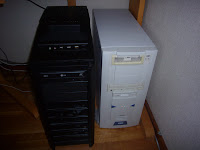
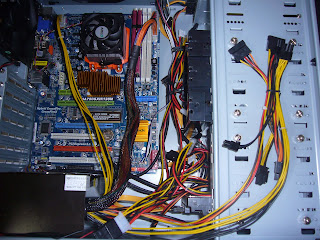
Of course there is a huge mess of cables but then again it's my first and I'm happy all the parts I chose work together as expected =D
And just for giggles here's the trusty glass penguin always sitting on my desk:

Gotta install the OS now...
More Details Really Really Soon =D
Edit:
System:
CPU: Phenom II x3 720 BE
Motherboard: ASRock M3A780GXH 128M
Case: Antec 900
Power Supply: AQTIS Double Graphic Power AP-650GTX
Memory: Just Some DDR3
Hard Drive: 1tb (Hitachi)
and a simple DVD/CD Reader/Writer
It doesn't have a Graphics Card yet but I'm going to get one soon (probably around Radeon 4770 HD or more). The integrated Motherboard Graphics (ATI Radeon 3200 HD) are doing fine so far but then again I've only tried Compiz Fusion and some Screen savers =D
It runs stable and it looks really great next to my old build:

Of course there is a huge mess of cables but then again it's my first and I'm happy all the parts I chose work together as expected =D

And just for giggles here's the trusty glass penguin always sitting on my desk:

Wednesday, July 1, 2009
Website Backups
Today I made a Website Backup. This post has nothing to do with the Server I'm currently working on. Unfortunately I didn't get time to work on it, as I promised myself that I would only work on it for an entire day at the minimum.
I made the site backup using the FileZilla FTP Client. Of course it runs on Linux, otherwise I wouldn't use it. It's quite convenient, here's a (huge) screenshot of it running:
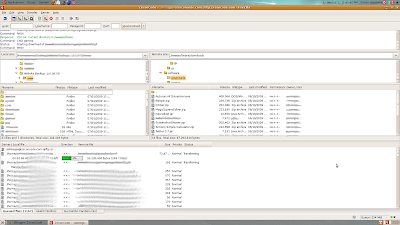
And yes, the blurry parts are not some cool graphic effects of the program, they where added in by me using GIMP for security reasons.
The backup took me quite some time. After realising it was going to take longer than expected, I wanted to know what exactly was so space consuming on my server. My first guess was correct, the pictures where to blame. In dismay I realised I had forgotten to compress them before uploading. This obviously wasn't good, so I started GIMP and slowly re-saved every picture at a lower quality. Of course this could have been done using a macro but there weren't that many pictures and I was bored. As a result my site may (should) load quicker now.
And that's all for today, just a quick post about my site Backups =)
I made the site backup using the FileZilla FTP Client. Of course it runs on Linux, otherwise I wouldn't use it. It's quite convenient, here's a (huge) screenshot of it running:

And yes, the blurry parts are not some cool graphic effects of the program, they where added in by me using GIMP for security reasons.
The backup took me quite some time. After realising it was going to take longer than expected, I wanted to know what exactly was so space consuming on my server. My first guess was correct, the pictures where to blame. In dismay I realised I had forgotten to compress them before uploading. This obviously wasn't good, so I started GIMP and slowly re-saved every picture at a lower quality. Of course this could have been done using a macro but there weren't that many pictures and I was bored. As a result my site may (should) load quicker now.
And that's all for today, just a quick post about my site Backups =)
Saturday, June 27, 2009
Server Day 1 - Brainstorming
During this great and incredible summer vacation I'm going to attempt to program a server. This server will be part of my MMORPG, hence the title. Today I just brainstormed what and how the server will act like.
First of all I had to decide on the protocol. While UDP is very quick, it's not very reliable. Packets may get lost a long the way and there is no way to know if they arrive in the same order that they where sent. TCP is of course the opposite. It is very reliable, however it is of course slower. I choose to go with TCP. The reason is that I need a reliable connection between my Server and Client to debug the Server easily. TCP is also easier to implement, which is an added bonus. Maybe when the server is up and running I will switch some things the server sends in an endless stream (like the players locations) to a UDP protocol to ease the load.
The serve will be programmed in C. The reason being is that C is very quick and reliable once all bugs have been found. I do not now C fully yet, however for the last month or so I have been playing around with C and some parts are extremely similar to Java, my current all time favorite. I'll have to learn a little bit of C while programming this server, not to speak of the idea of sockets, something which I have never looked at before. Overall this server will be a tremendous learning experience, I will have gained a lot from it even if it ends up in heaps and ashes (something which I am positive won't happen) =D
The server will run on Linux. Linux is just more reliable. Period. My chosen Linux OS is Ubuntu. The reason behind this is that I have been using Ubuntu for the past year now and only switched to windows for the occasionally PowerPoint presentation I had to create for "educational means". I have my old computer lying around and I thought I might install Ubuntu on it and see where it goes from there =D
Now how do I test the server? Well my idea is that I will connect my main computer to my old computer (via LAN of course). After that I 'm going to install SSH on my old computer so I can compile and run the C code through SSH. That's what I'm going to try to do next.
This post has become very long and I hate to see it end, but if I would write about everything I have brainstormed the next few posts would look like nothing you've ever seen, simply because you wouldn't be able to see them =D
First of all I had to decide on the protocol. While UDP is very quick, it's not very reliable. Packets may get lost a long the way and there is no way to know if they arrive in the same order that they where sent. TCP is of course the opposite. It is very reliable, however it is of course slower. I choose to go with TCP. The reason is that I need a reliable connection between my Server and Client to debug the Server easily. TCP is also easier to implement, which is an added bonus. Maybe when the server is up and running I will switch some things the server sends in an endless stream (like the players locations) to a UDP protocol to ease the load.
The serve will be programmed in C. The reason being is that C is very quick and reliable once all bugs have been found. I do not now C fully yet, however for the last month or so I have been playing around with C and some parts are extremely similar to Java, my current all time favorite. I'll have to learn a little bit of C while programming this server, not to speak of the idea of sockets, something which I have never looked at before. Overall this server will be a tremendous learning experience, I will have gained a lot from it even if it ends up in heaps and ashes (something which I am positive won't happen) =D
The server will run on Linux. Linux is just more reliable. Period. My chosen Linux OS is Ubuntu. The reason behind this is that I have been using Ubuntu for the past year now and only switched to windows for the occasionally PowerPoint presentation I had to create for "educational means". I have my old computer lying around and I thought I might install Ubuntu on it and see where it goes from there =D
Now how do I test the server? Well my idea is that I will connect my main computer to my old computer (via LAN of course). After that I 'm going to install SSH on my old computer so I can compile and run the C code through SSH. That's what I'm going to try to do next.
This post has become very long and I hate to see it end, but if I would write about everything I have brainstormed the next few posts would look like nothing you've ever seen, simply because you wouldn't be able to see them =D
Friday, June 12, 2009
Exams Ended & Got tons to Do !
Those terrible terrible worthless ugly exams are over!
I have two months of free time now! YAY!
Jealous Much?
Here's all the fun stuff I'm planning to do:
(I'll strike them out as I finish them)
- Get my Site up to Date
-- Update Articles
-- Update Software Section
-- Maybe add a Login Section
-- Add Comment Section
-- Add a ToDo list
-- Finish of the CSS
- Create a New Blogger Style
-- Similar to Style of my Site
- Install SSH on an OLD laptop
-- Wipe HardDrive
-- Somehow get a Command Line Running
-- Note: Windows and X Window Server don't work
- Help a Friend finish psp.zirconcode.com
- Read a Book on the Linux Kernel
-- 19 / 19 Chapters Left to Read
Those are the things which I'm going to finish first. After that, I'm going to start on the more heavy stuff =D
Edit:
The ToDo list has moved to my sites ToDo section.
I have two months of free time now! YAY!
Jealous Much?
Here's all the fun stuff I'm planning to do:
(I'll strike them out as I finish them)
- Get my Site up to Date
-- Update Articles
-- Update Software Section
-- Maybe add a Login Section
-- Add Comment Section
-- Add a ToDo list
-- Finish of the CSS
- Create a New Blogger Style
-- Similar to Style of my Site
- Install SSH on an OLD laptop
-- Wipe HardDrive
-- Somehow get a Command Line Running
-- Note: Windows and X Window Server don't work
- Help a Friend finish psp.zirconcode.com
- Read a Book on the Linux Kernel
-- 19 / 19 Chapters Left to Read
Those are the things which I'm going to finish first. After that, I'm going to start on the more heavy stuff =D
Edit:
The ToDo list has moved to my sites ToDo section.
Monday, May 25, 2009
Exams coming up
Yup, that's right. I have exams in exactly two weeks. I apologise, I don't have much time at hand right now to do anything, I'm wasting using up all my time studying.
And guess what the good news is?
After that I get a 2 month vacation =D
Plans for Summer Break:
1. Finish of Website (remove bugs, update content)
2. Work on a MMORPG (hopefully finish Beta!)
3. Work on my Neural Net
4. Write tons of tutorials (AI/HTML/CSS/DOS/BASH/PHP/C/Java/Delphi/etc...)
5. Have Fun =D
I really can't wait =(
And guess what the good news is?
After that I get a 2 month vacation =D
Plans for Summer Break:
1. Finish of Website (remove bugs, update content)
2. Work on a MMORPG (hopefully finish Beta!)
3. Work on my Neural Net
4. Write tons of tutorials (AI/HTML/CSS/DOS/BASH/PHP/C/Java/Delphi/etc...)
5. Have Fun =D
I really can't wait =(
Sunday, May 10, 2009
Website Remake
Just a quick update since I don't have much time right now:
I just re-created my websites (www.zirconcode.com) style and it looks a lot better to me now. Maybe I'll Open Source my old style, it might help somebody. Next I'm going to update and organise ALL the content on it. I don't know yet what to do after that, probably work on one of my projects again.
Have a nice day =D
I just re-created my websites (www.zirconcode.com) style and it looks a lot better to me now. Maybe I'll Open Source my old style, it might help somebody. Next I'm going to update and organise ALL the content on it. I don't know yet what to do after that, probably work on one of my projects again.
Have a nice day =D
Thursday, April 30, 2009
Learning BASH (part 1)
What's BASH?
BASH (GNU Bourne-Again SHell) is the scripting language used in mostly Linux Environments. If you don't know what Linux is or don't have a Linux based OS installed on your computer right now visit: http://www.linux.com/whatislinux/114354. For this blog post, I will recklessly assume that you are using Ubuntu, as that's what I'm using right now. If you're not using Ubuntu, things will hopefully work out anyway (they should, at least). BASH and Linux can be compared to DOS and Windows.
Why Learn It?
If your Operating System doesn't boot any more, booting into a BASH console (Ubuntu recovery mode) instead into an X Window Server (the thing which manages the windows which you're probably looking at) is a great and easy way to recover your files and fix your booting process. BASH can also be an easy and quick way to get things done around your great open source OS.
How to Learn It:
Now that I've (hopefully) convince you to learn BASH, let's learn it =D
First of all, you will need to find a way to access a BASH console. In Ubuntu such a terminal can be found under: /usr/bin/gnome-terminal (navigate to /usr/bin/ and double click on gnome-terminal to open it). I suggest you create a shortcut to it by dragging it onto your Desktop while holding CTRL + SHIFT.
Once open, you will hopefully see this (if Simon is your name and Simon-Ubuntu-8 is your computers name):
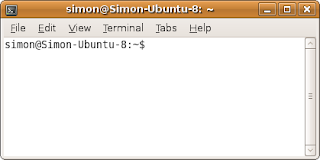
Want to change the Colors to something (hopefully) better looking? Click on "Edit" in the toolbar, then click on "Profile Preferences" on the drop down menu. Finally click on the "Colors" tab on the window which just opened. After changing the colors to what you want them to be, close the options window and lets get started =D
Do you see the "$" at the end of the first line on the terminal? That means the terminal is waiting for you to command it. Let's not make it wait for too long =D
Make sure the terminal window has your mouse focus by clicking on it, then type:
man
Hopefully the terminal replied like this:
What manual page do you want?
And then displaying your name and the "$" sign once again, ready for the next command.
Now what have you just done? You have told the console to run a file called "man" (stands for manual) and to display the results. Do you want to know where the "man" file is located?
Type in:
which man
And here's what I got:
/usr/bin/man
As you can see, typing in "which" and then a command name will tell you the file where that command is stored. Now let's go back to the "man" command. Typing in "man" and then a command name will tell you everything about that command.
Try typing:
man ls
You will get something which looks like this:
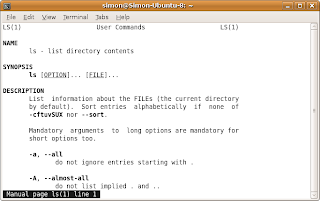
If you look at the bottom left corner, it will tell you what you are looking at and the line you are currently on. You can navigate up and down by using (Surprise!) the UP and DOWN arrow keys. Once you are done reading about the "ls" command you can press Q (as in Quit) to go back to your familiar console. The "man" command is VERY IMPORTANT, use it to check up on commands you don't know about before you use them. ALWAYS.
As you have hopefully figured out by now, the "ls" command lists the files of the directory you are currently looking at. Try it out if you want to =D
That's all nice and good but how do you know in which directory you are at the moment, and how do you change it?
Do a man look up on "pwd" by typing:
man pwd
After reading, press Q to exit, as I told you above.
Hopefully you have figured it out by now, the "pwd" command Prints the Working Directory, so the directory you are currently in.
Try it:
pwd
I got:
/home/simon
Now you could type:
ls
To get a list of files in the /home/simon directory.
Now how do we navigate around our directories?
Use the "cd" command. Typing in "man cd" gets you: "No manual entry for cd", so don't even bother. Instead, read this: Typing "cd" and a sub-directory name will change your current directory to that.
Let's try it =D
Find your current directory by typing:
pwd
Here's mine:
/home/simon
Now type "cd" and a sub-directory:
cd Desktop
Then find your current directory again by typing:
pwd
And be surprised, it changed:
/home/simon/Desktop
Here are some other useful things you can do with the "cd" command:
Type in "cd /" to navigate to the root directory.
Type in "cd .." move to the parent directory.
The End (for now).
What, but there is so much left to learn?!
Yes, there is. I will write more later this week (hopefully). This tutorial was quite fun to write so I think I will make a tutorial series.
In the mean time, look up these basic commands (using "man" or Google):
BASH (GNU Bourne-Again SHell) is the scripting language used in mostly Linux Environments. If you don't know what Linux is or don't have a Linux based OS installed on your computer right now visit: http://www.linux.com/whatislinux/114354. For this blog post, I will recklessly assume that you are using Ubuntu, as that's what I'm using right now. If you're not using Ubuntu, things will hopefully work out anyway (they should, at least). BASH and Linux can be compared to DOS and Windows.
Why Learn It?
If your Operating System doesn't boot any more, booting into a BASH console (Ubuntu recovery mode) instead into an X Window Server (the thing which manages the windows which you're probably looking at) is a great and easy way to recover your files and fix your booting process. BASH can also be an easy and quick way to get things done around your great open source OS.
How to Learn It:
Now that I've (hopefully) convince you to learn BASH, let's learn it =D
First of all, you will need to find a way to access a BASH console. In Ubuntu such a terminal can be found under: /usr/bin/gnome-terminal (navigate to /usr/bin/ and double click on gnome-terminal to open it). I suggest you create a shortcut to it by dragging it onto your Desktop while holding CTRL + SHIFT.
Once open, you will hopefully see this (if Simon is your name and Simon-Ubuntu-8 is your computers name):

Want to change the Colors to something (hopefully) better looking? Click on "Edit" in the toolbar, then click on "Profile Preferences" on the drop down menu. Finally click on the "Colors" tab on the window which just opened. After changing the colors to what you want them to be, close the options window and lets get started =D
Do you see the "$" at the end of the first line on the terminal? That means the terminal is waiting for you to command it. Let's not make it wait for too long =D
Make sure the terminal window has your mouse focus by clicking on it, then type:
man
Hopefully the terminal replied like this:
What manual page do you want?
And then displaying your name and the "$" sign once again, ready for the next command.
Now what have you just done? You have told the console to run a file called "man" (stands for manual) and to display the results. Do you want to know where the "man" file is located?
Type in:
which man
And here's what I got:
/usr/bin/man
As you can see, typing in "which" and then a command name will tell you the file where that command is stored. Now let's go back to the "man" command. Typing in "man" and then a command name will tell you everything about that command.
Try typing:
man ls
You will get something which looks like this:

If you look at the bottom left corner, it will tell you what you are looking at and the line you are currently on. You can navigate up and down by using (Surprise!) the UP and DOWN arrow keys. Once you are done reading about the "ls" command you can press Q (as in Quit) to go back to your familiar console. The "man" command is VERY IMPORTANT, use it to check up on commands you don't know about before you use them. ALWAYS.
As you have hopefully figured out by now, the "ls" command lists the files of the directory you are currently looking at. Try it out if you want to =D
That's all nice and good but how do you know in which directory you are at the moment, and how do you change it?
Do a man look up on "pwd" by typing:
man pwd
After reading, press Q to exit, as I told you above.
Hopefully you have figured it out by now, the "pwd" command Prints the Working Directory, so the directory you are currently in.
Try it:
pwd
I got:
/home/simon
Now you could type:
ls
To get a list of files in the /home/simon directory.
Now how do we navigate around our directories?
Use the "cd" command. Typing in "man cd" gets you: "No manual entry for cd", so don't even bother. Instead, read this: Typing "cd" and a sub-directory name will change your current directory to that.
Let's try it =D
Find your current directory by typing:
pwd
Here's mine:
/home/simon
Now type "cd" and a sub-directory:
cd Desktop
Then find your current directory again by typing:
pwd
And be surprised, it changed:
/home/simon/Desktop
Here are some other useful things you can do with the "cd" command:
Type in "cd /" to navigate to the root directory.
Type in "cd .." move to the parent directory.
The End (for now).
What, but there is so much left to learn?!
Yes, there is. I will write more later this week (hopefully). This tutorial was quite fun to write so I think I will make a tutorial series.
In the mean time, look up these basic commands (using "man" or Google):
- echo
- sleep
- su (useful)
- true
- false
- netstat (useful)
- ifconfig (useful)
- ping (somewhat useful)
- open (useful)
- cat (useful)
- mkdir (useful)
- rmdir (useful)
Subscribe to:
Posts (Atom)